
Knowledge-grounded answers
We prepare documents and available knowledge sources for the use case, designing for visible sources, freshness and limitations.
- Knowledge source structure
- Answers and source presentation
AI SERVICES / ASSISTANTS & AGENTS
We build AI assistants that understand your notes, plan the work and move with you. Try it with a meeting note.
Let’s adapt it to your businessYour words become a plan that works together.
Describe who needs to do what, and when. We’ll fill in the gaps together.
A prepared output example; no AI is run.
When you run it, your notes are sent to OpenAI for processing. The board stays on this page.
Tasks, owners, dates. Everything your notes turn into will find its place here.
Start with your notes; let’s work out the next step together.
Intelligence that starts with a conversation and carries into your work.
AI Assistants and Agent Development
We develop AI assistants for specific tasks your teams or customers need to complete. Knowledge sources, access boundaries, response behavior and tool use are designed together.
An assistant that answers questions and an agent that acts in other systems need different scopes. Permissions and human oversight follow the use case.
What we deliver
We prepare documents and available knowledge sources for the use case, designing for visible sources, freshness and limitations.
We define which services the assistant can use and when, connecting data retrieval, drafting or initiating a specific action in a controlled way.
We define useful answers and successful tasks through example scenarios, evaluating quality, latency, cost and failure behavior together.
The work in context
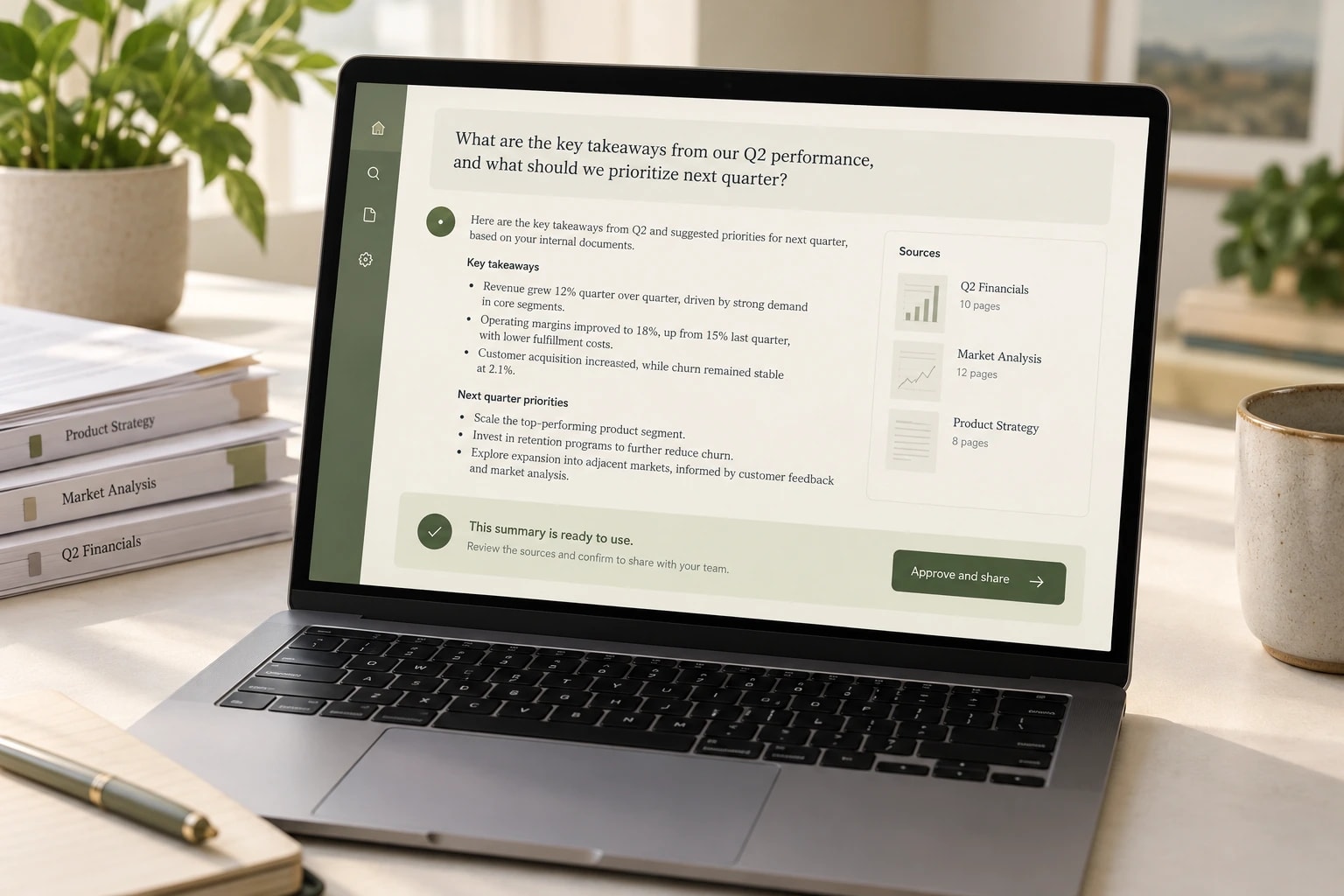
An example knowledge assistant can organize documents around a question and prepare a draft. Reviewing sources and approving an external action are part of the designed flow.
How we work together
Deliverables and the working plan are defined around the needs of your project.
Define the user, information need and success criteria.
Review knowledge, permissions and connected tools.
Test behavior against example questions and tasks.
Complete the interface, monitoring and human approval where needed.
Engineering in the details
Information a user cannot access should not become available through the assistant.
Insufficient information and unverified answers need clear feedback and next steps.
Tool inputs, permissions and failure conditions are validated by the application.
Common questions
We review source types and access, then design retrieval and response flows. Freshness, ownership and user permissions are part of the scope.
No. Permissions and automation depend on the task’s impact. Drafting, acting with approval and providing information are different design options.
Data types, provider terms, hosting needs, cost and quality expectations are considered together. Appropriate access and processing conditions are defined at the start.
Share the users, the knowledge they need and the output you expect.